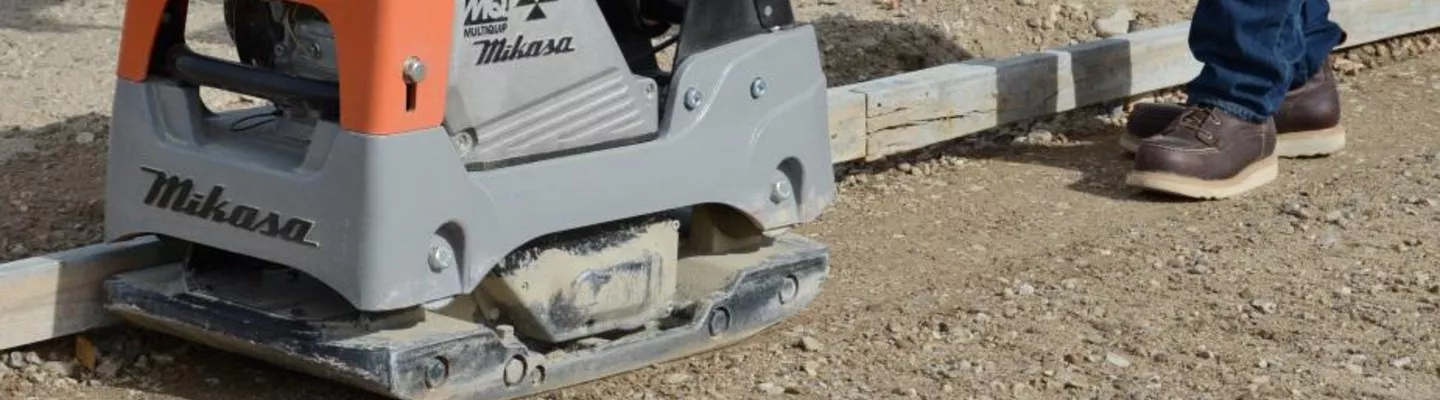
Use a vibratory plate compactor with the right force, and the job will get done in no time.
Article Updated on: September 24, 2026
Whether you’re paving a driveway or parking lot, putting in a walkway, building a patio, repairing a street or backfilling a trench, success starts with compacting the earth and any material you’re laying down. Compacting the ground surface helps avoid shifts caused by moisture or pressure that can result in an uneven surface. You also want to avoid over-compacting, which can compromise the strength of the soil.
To get the right foundation for your project, you’ll need the right vibratory plate compactor. Plate compactors exert force on the ground using a large plate, usually made from steel, that vibrates rapidly. The force compacts the soil, and the vibration encourages the grains to move closer together, eliminating air pockets and providing tighter compaction.
Plate compactors are good for compacting granular soils such as gravel, sand, stone dust and 2A aggregates (sandy gravel). They can also be used on cobblestones and paving blocks.
What types of vibratory plate compactors are available?
When renting a vibratory plate compactor, you have three main options to choose from:
- Single vibratory plate compactors: These are the smallest and lightest plate compactors. They can move only forward, not backward, so maneuverability is limited. They generally exert a force between 2,000 pounds and 6,000 pounds and are good for compacting smaller areas of dirt, gravel or asphalt.
- Reversible vibratory plate compactors: These can move forward and backward, making it easier to cover large areas. They provide deeper compacting because they exert a greater force, typically up to 16,000 pounds, so they’re perfect for driveways or cobblestones.
- Heavy-duty (high-performance) plate compactors: These compactors exert the largest force. They can compact soils with clay content, which need extra force because the particles are not easily vibrated into closer contact. (For high clay or silt content material, a drum roller or jumping jack rammer compactor may work better.)
Type | Movement | Typical Force | Best For |
|---|---|---|---|
Single vibratory plate compactor | Forward only | 2,000 to 6,000 pounds | Smaller areas of dirt, gravel or asphalt |
Reversible vibratory plate compactor | Forward and backward | 6,000 to 16,000 pounds | Large areas, driveways or cobblestones |
Heavy-duty (high-performance) plate compactor | Forward and backward | Highest force output | Soils with clay content requiring extra force |
How much compaction force do you need?
The amount of force required depends on the type of earth, what material you’re laying down and how thick the layer of material is. Vibratory plate compactors come with a force rating, usually presented in pounds. The impact force measures how much force it would take for the machine to make a dent in a metal plate — a way for the manufacturer to display strength.
The centrifugal force measures the force produced by the machine’s vibration. Units with more force will penetrate deeper into the soil. A rule of thumb is that a compactor will compact 1 inch of material for every 1,000 pounds of compaction force it exerts.
You should also consider the machine’s vibration frequency, measured in vibrations per minute (vpm). Higher vibration frequency (around 5,700 vpm) is good for compounding thin layers of material. Lower frequency (3,000 to 4,000 vpm) is used for thicker layers of material.
What other factors should you consider before renting a vibratory plate compactor?
Here are other factors to take into account:
- Fuel source: Vibratory plate compactors are most commonly powered by diesel or gasoline, although some electric options are available. Consider what fuel is easily accessible in and around your worksite.
- Water tank capabilities: Many vibrating plate compactors can be fitted with a water tank. The tank creates a layer between the plate and sticky material like asphalt. If you will be working with asphalt, choose a vibrating plate compactor that can be equipped with a water tank.
- Operator comfort: Plate compactors vibrate, which can make operating them uncomfortable. Choose one with vibration-isolated steering handles to make operating it less taxing on workers.
- Transport: Vibratory plate compactors are large and heavy. Look for a machine with lift handles and/or lift eyes for easy transport.
Many paving and compacting jobs will require that you use a jumping jack rammer in addition to a plate compactor. Rammers have a thinner surface than plate compactors and exert greater force. Because of that, they’re good for working in narrow spaces or with moist soils.
 Facebook
 X
 Linkedin
 Email
 Print
 Copy Link
 RSS Feed