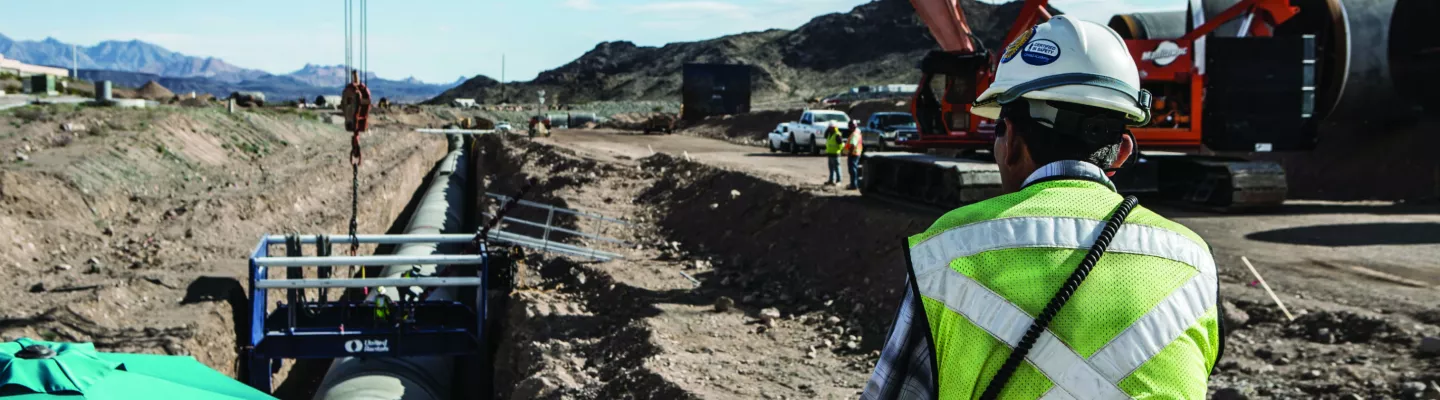
Misunderstanding when or how to use a trench box can put workers in danger.
Article Updated on: October 02, 2026
For some contractors, confusion exists around OSHA’s trench box requirements. Understanding when it’s appropriate to use a trench box and how to use one according to regulation is critical to keeping workers safe.
What is a trench box?
Trench boxes, also called trench shields or trench sheets, are one type of protective system. They aren’t designed to shore or prevent a trench wall from collapsing. Instead, they’re designed to protect workers from the pressure and weight of soil in the event of a cave-in. Unlike a shoring system, a trench box doesn’t provide any structural strength to the excavation itself.
Trench boxes are designed and built to withstand a lot of pressure from the earth that surrounds them. (One cubic yard of soil weighs 3,000 pounds, almost as much as a car.) Therefore, trench boxes are made from aluminum or steel, with sidewalls of varying thicknesses held apart by spreaders or other trench box panels of the same materials to achieve the desired width. The soil pressures and depth ratings on a trench box are determined by their designs.
Protective System | How It Protects Workers | Provides Structural Support to Trench Walls | Typical Use Case | OSHA Depth Trigger |
|---|---|---|---|---|
Trench Box (Shield) | Protects workers from soil pressure and weight if a cave-in occurs | No — does not prevent wall collapse | Utility work, pipe installation, linear excavations | 5 feet or more (or less in cave-in-prone soil) |
Shoring System | Physically supports and prevents trench walls from collapsing | Yes | Excavations near structures or where space is limited | 5 feet or more (or less in cave-in-prone soil) |
Sloping/ Benching | Cuts trench walls at an angle or in steps to reduce cave-in risk | No — relies on excavation geometry, not equipment | Open excavations with adequate space for slope grading | 5 feet or more (or less in cave-in-prone soil) |
What are OSHA’s trench box requirements?
OSHA has several regulations outlined in OSHA 29 CFR Part 1926.650-.652 Subpart P-Excavations that apply to the installation and use of trench boxes. Here are some of the most important points:
- Restrict lateral movement: A contractor should install a trench box in a way that restricts its lateral movement if there’s a sudden load placed on it (for instance, the earth starts to cave in or shift). The space between the excavation side and the trench box should be backfilled to ensure it’s as small as possible.
- Limit the gap below the box: The maximum distance between the bottom of the trench box and the bottom of the trench should be no more than 2 feet. A contractor can excavate up to 2 feet under a trench box as long as there’s no indication that the soil is collapsing behind the shield or below it, and the shield is rated for the full depth.
- Extend the box when combined with other systems: A trench box can be used in combination with other protective systems, such as sloping and benching. Under that circumstance, the trench box must extend 18 inches above the vertical part of the excavation walls to keep dirt, rocks and other debris from rolling into the trench. If the top of the trench box is at ground level, however, the trench box does not have to extend 18 inches above grade.
- Match the box to depth and soil conditions: Trench boxes must be able to handle the pressure at the depth where they’ll be used and for the type of soil they’ll be used in. The competent person can use the manufacturers’ tabulated data to determine if a trench box is appropriate for a particular situation. If a trench is deeper than 20 feet, contractors must use a registered professional engineer (RPE) to design the trench box, or select the right trench box for the depth of the excavation using manufacturer’s tabulated data.
- Stack boxes for deeper trenches: As trenches get deeper, trench boxes can be stacked on top of one another to provide the necessary protection for workers. Each trench box must be designed to resist the pressure of the earth at the level where it’s being used. In other words, contractors don’t have to use the same trench boxes for the top or the middle of the stack that they’d use for the bottom. OSHA advises using some kind of designation system to differentiate the trench boxes when they’re going to be used in a stack. For example, you could mark each trench box with the maximum depth at which it can be used.
- Never occupy the box during movement: Workers can’t remain in the trench box when it’s being installed, taken out or moved vertically.
- Provide accessible egress: People working in a trench box must have access to a ladder or other means of egress. The ladder must be secured and located within 25 lateral feet of all workers, and it must extend beyond the top of the trench by 3 feet. If the workers are using a structural ramp as their egress, a competent person qualified in structural design has to design it.
Maintain trench safety with United Rentals
Designating a competent person and making sure that person is adequately trained is one of the most important steps to preventing trench injuries and fatalities. In addition, OSHA requires employers to train employees on the hazards they may be exposed to, how to protect themselves and what PPE is necessary to work safely.
United Rentals offers training and certifications through our United Academy program that meet OSHA requirements. We provide online and in-person trench safety trainings for competent persons, excavation safety, OSHA safety standards, confined space safety, personal protective equipment (PPE) and more.
 Facebook
 X
 Linkedin
 Email
 Print
 Copy Link
 RSS Feed